Politics
Taxpayer-Funded PSA Stars President Teaching Americans to Love the Country They’re Funding
One Ohio dad did the math on his share of the president's "PSA" and would like his tote bag now.
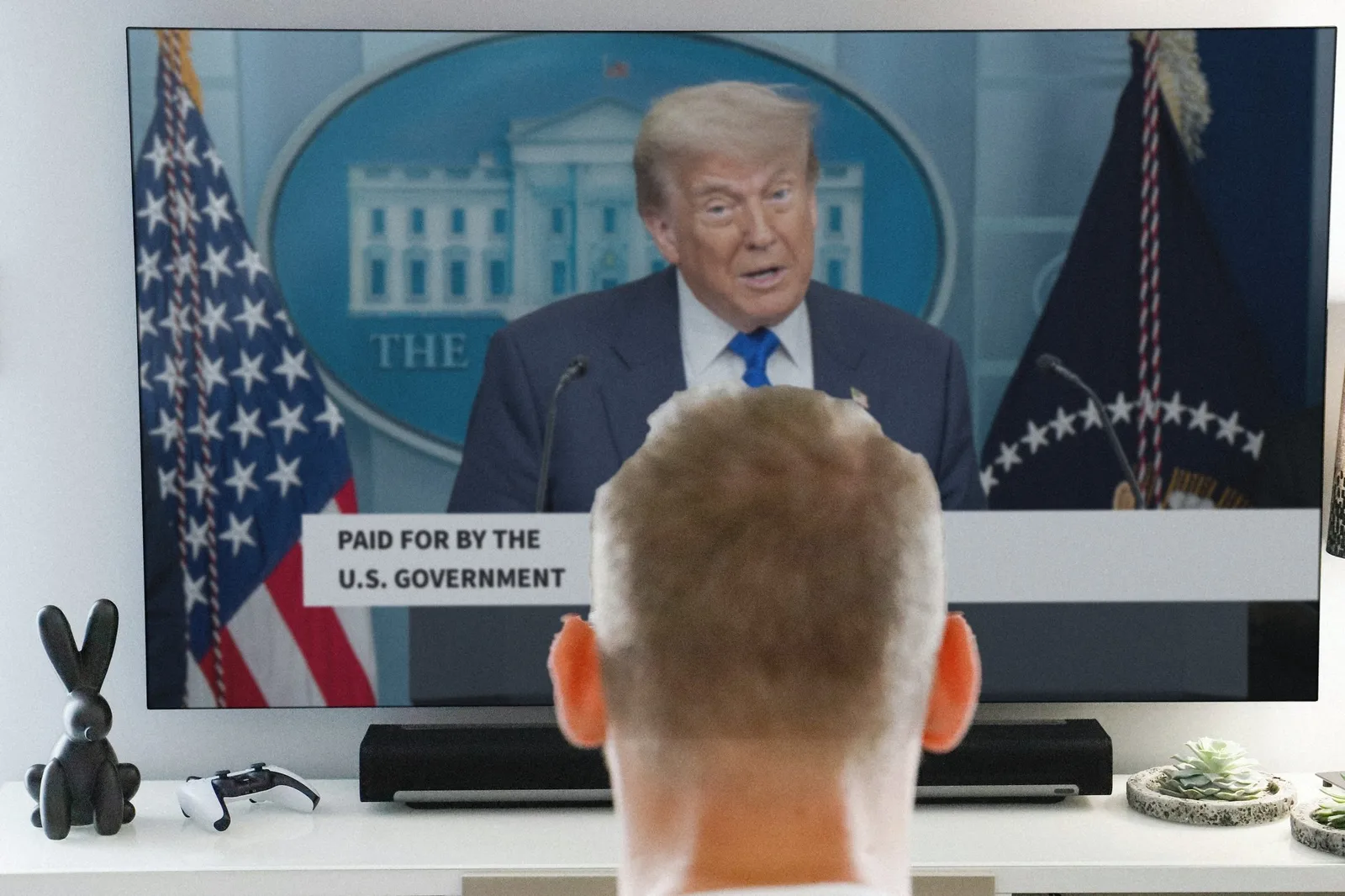
Columbus, OH — During a commercial break Tuesday night, Doug Rindle paused a spoonful of cereal to watch a sleek federal “public service announcement” reminding Americans to love their country. The star of the spot was President Donald Trump. The fine print at the end said the U.S. government had paid for it, which Rindle eventually worked out meant he had.
“I thought, that’s nice, somebody’s finally teaching civics,” said Rindle, 52, an HVAC tech who was halfway through a bowl of Frosted Mini-Wheats. “Then I realized the somebody was me. I’m the budget.”
The Trump administration has allocated $20 million in Department of Homeland Security funds for television ads the White House describes as educational PSAs, not campaign spots, even as the midterms approach. One ad shows the president slowly walking down a hallway in black and white, describing “the final battle” against “the deep state.” Another mixes rally footage with onscreen text about the “largest tax cuts in history.” All end with “Paid for by the U.S. Government.”
The White House has called the spots “very clearly not campaign ads” and “a reminder for Americans to love their country and know why it’s worth defending.” Rindle said he already loved America and had the withholding statements to prove it.
“If the lesson is ‘love your country,’ and the tutor is the guy in charge, and the invoice comes out of my paycheck,” he said, “that’s a closed loop. That’s a love triangle with one person and a W-2.”
Doing the Math
Rindle spent the rest of the evening at the kitchen table with a calculator and the back of a gas bill, dividing $20 million by what he guessed was the number of households in America. He arrived at roughly fifteen cents. “Fifteen cents doesn’t sound like much,” he said. “But when PBS takes my money, I get a tote bag. I paid for this, and I didn’t even get the mug.”
His wife, Tammy Rindle, 50, a school bus dispatcher, said he has been asking about the tote bag since Tuesday. “He waited through two more commercial breaks to see if there’d be a phone number to call,” she said. “Then he asked our son if there’s a premium tier of America without the ads.”
Their son, Kyle, 16, said he explained that the spots air on live television, mostly during football, and cannot be skipped. “Dad said he doesn’t want to skip it,” Kyle said. “He wants to be thanked in the credits.”
Next door, retired mail carrier Gary Plotz, 67, said he caught the hallway ad during a Sunday NFL game and assumed it was for a pickup truck. “Black and white, a guy walking slowly, very serious music. I was waiting for a tailgate to open,” Plotz said. “When it said the government paid for it, I figured the truck must be expensive.”
A Closed Loop
Former FCC ethics lecturer Pauline Gorp called the arrangement “structurally efficient.” “You have the product, the salesman, and the customer sharing one wallet,” Gorp said. “It’s vertical integration of patriotism.”
Gorp, who now runs the Center for Commercial Break Studies out of a converted Blockbuster in Dayton, said a survey of 1,100 Ohio viewers found that 58 percent could not tell whether the spots were PSAs or campaign ads, 31 percent thought they were for a truck, and 11 percent said they would have loved the country anyway and asked for a refund of the difference. “People were raised on Smokey Bear,” Gorp said. “Smokey never once asked you to love him personally.”
Senate Majority Leader John Thune, R-S.D., said of the ads, “It’s a great message, I like the message, but it shouldn’t be paid for by taxpayer dollars,” a position Rindle said he “respects, as the taxpayer dollars.” Federal Communications Commission Chair Brendan Carr said the ads did not “merit any sort of FCC review,” which Rindle took to mean he had to review them himself.
President Trump told reporters in the Oval Office, “I’m promoting the country,” adding, “if somebody said that that’s wrong, I’ll gladly pay the money.” Rindle has since written “SOMEBODY” on a sticky note, stuck it to the TV, and left his Venmo open on the coffee table. “I’m not saying it’s wrong,” he said. “I’m just saying I’m very easy to find.”
At publishing time, Rindle had rewound the ad twice, muttered “for the country,” and set a calendar reminder for April to see whether the PSA counted as a charitable donation. By the third viewing, Tammy reported, he had stood up and placed a hand over his heart, explaining that he now loved America more than ever, “mostly out of sunk cost.”